

My lower back has been talking to me for about a decade now. Twenty-seven years on a walking mail route will do that, and so will yard work, long drives to Ohio, and the occasional bad night of sleep. When the stiffness flares, I want something that works in the living room, not something that requires a therapist's appointment. That is where the TOLOCO Massage Gun came in. Before I picked one up, I checked with my physical therapist, and that is the first rule of this whole article: a massage gun is a tool for everyday muscle stiffness, not a treatment for a diagnosis. If your back pain is real, sharp, or getting worse, talk to a doctor or physical therapist before you buy anything.
What follows is the routine I actually use, step by step, the way I would explain it to a friend at the kitchen table. I am not a clinician and I am not going to pretend otherwise. I am a guy with a cranky back who has spent years working with a physical therapist and trying a lot of gear at home. The TOLOCO is the massage gun that stayed in my rotation, and these are the safety rules I wish someone had handed me on day one.
The TOLOCO Massage Gun Made My Evening Routine 15 Minutes Shorter
It is the percussion massager I reach for when my lower back tightens up after yard work or a long drive. Easy to hold, easy to control, and quiet enough to use while Diane watches TV.
Amazon Check Today's Price on Amazon →Step 1: Get the Setup Right Before You Turn It On
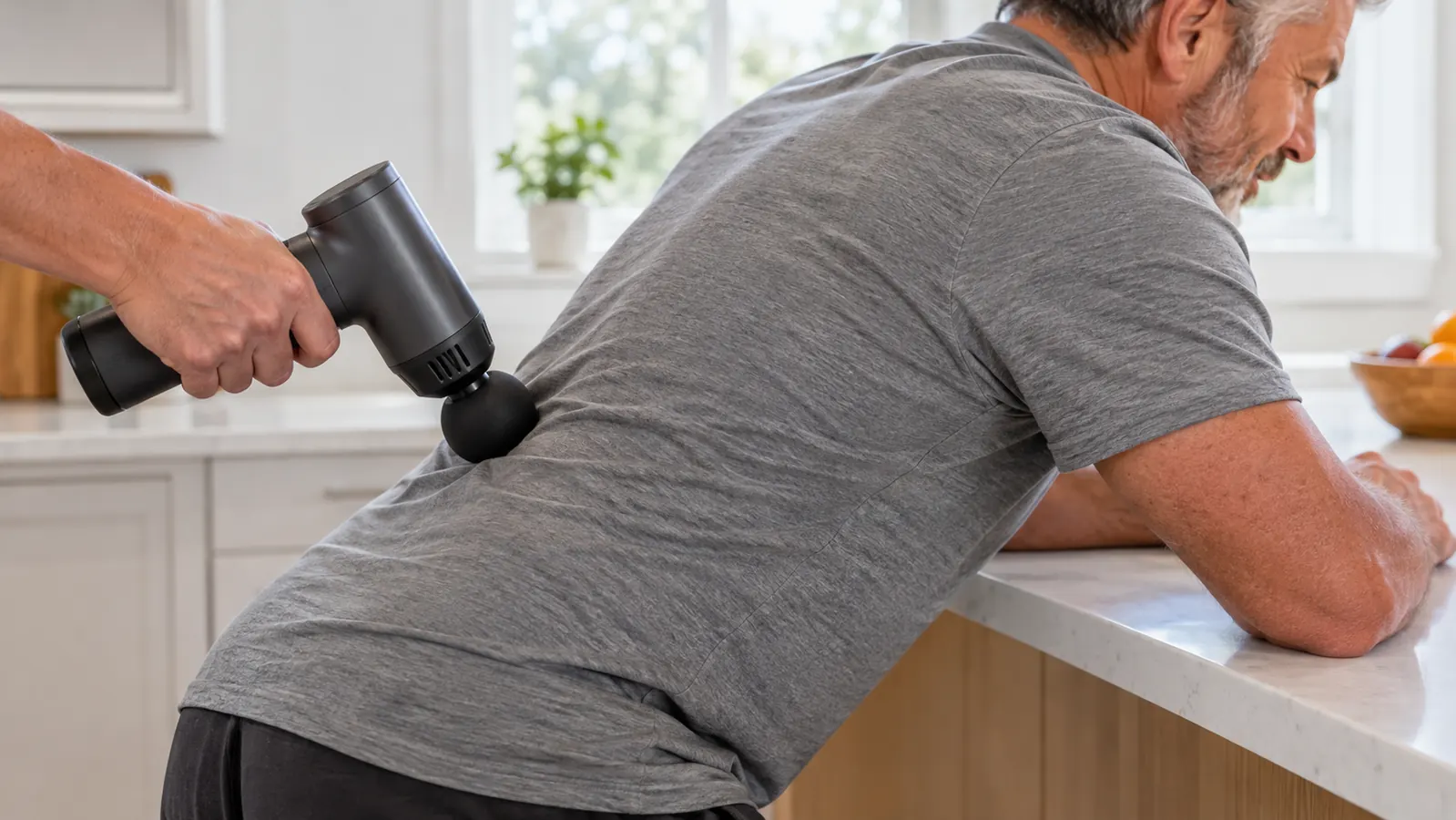
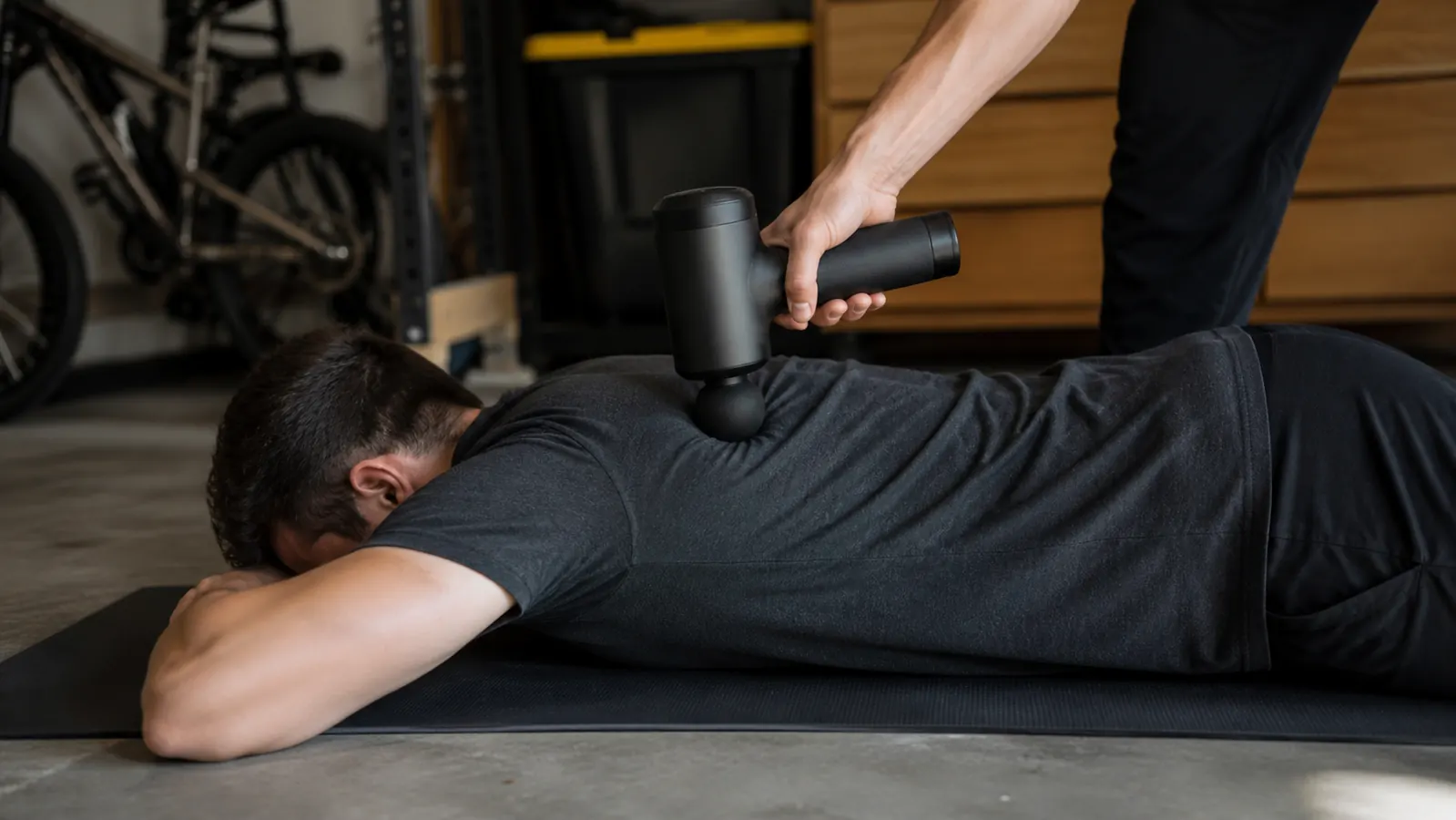
The massage gun does nothing useful if you are standing in an awkward position trying to reach your own back. I learned this the hard way in my garage gym, twisting around and tensing up so much that I was working against the tool the whole time. Now I do one of two things. Most nights I sit on the edge of my living room recliner, feet flat on the floor, and lean forward just enough to give myself room to reach. When my back is tighter, I lie face down on a mat in the garage with a pillow under my hips, which takes all the effort out of the position and lets the muscles actually relax.
The second part of the setup is the attachment. The TOLOCO comes with several heads in the box, and this matters more than people think. For the lower back I use the rounded ball attachment almost every time. It spreads the force over a wider area, which is what you want over the big muscles on either side of the spine. I save the pointed attachments for places where I want more precision, like the knot in my shoulder after a long day of reading. The rule I follow is simple: when in doubt, use the rounder head and the gentler setting.
Third, and I cannot say this strongly enough: never run the massage gun directly over your spine, your tailbone, or your kidneys. The tool is for the muscle on either side of the lower back, not the bones and not the organs. My physical therapist put it to me this way: treat the massage gun like a strong hand, not a power tool. A strong hand would never press straight down on a bone, and neither should this.
Step 2: Start on the Lowest Speed, Always
The TOLOCO has multiple speed settings, and the temptation is to crank it up because a high speed feels like it is doing more. It is not. When my back is already tight, a high speed makes the muscles guard up, which is the opposite of what I want. I start on the lowest setting every single time, even on days when my back feels fine. It takes about twenty seconds for the muscle to get the message and start softening, and then I can decide whether to bump the speed up one notch.
The other reason to start slow is that it gives you a chance to feel what is actually going on. If the lowest setting hurts, that is information. It tells me the area is too irritated for percussion that day, and I switch to heat or a gentle stretch instead. The massage gun is not a punishment and it should not hurt. A strong, strange, sometimes almost ticklish sensation is normal. Pain is not. That distinction has saved me from making a bad day worse more times than I can count.
A good test for the lowest setting is how your back feels thirty seconds in. You want it to feel like a firm, pleasant buzz that loosens things up, not like something you are bracing against. If you catch yourself holding your breath or tensing your stomach, the speed is too high or you are pressing too hard. With the TOLOCO I spent my whole first week on the first setting with the round head, and I am glad I did. My back adjusted to it, and I learned which spots wanted attention before I ever touched a faster speed.
Step 3: Work the Muscles, Not the Spot
Here is the mistake almost everyone makes with a first massage gun, and I made it too: finding the one sore spot and hammering it for ten minutes. That feels productive and it is usually wrong. The muscles in the lower back work as a group, and the tight spot is often just the place where the whole group is complaining. What helped me was thinking in terms of the whole area: the big muscles on both sides of the lower spine, the glutes, and the top of the hip.
My routine goes like this. I start on the side that feels tighter and move the ball attachment in slow, broad circles, about the speed of a lazy second hand on a clock. I let the tool travel along the muscle rather than parking it in one spot. After a minute or two on one side, I switch to the other side, even if it does not feel tight. The back likes balance, and doing only the painful side is how you end up with a new ache on the other side. Then I spend a minute on each glute, because a tight lower back and tight glutes travel together more often than not.
The total session is usually five to eight minutes, not thirty. That was the other thing my physical therapist corrected for me: more time with the massage gun is not more relief. Five focused minutes of slow, broad work beats twenty minutes of hammering one knot, and it leaves the muscle relaxed instead of irritated.
Step 4: Match the Pressure to How Your Back Feels That Day
The same setting is not right every day, and that was a hard lesson for me. Some evenings my back is just stiff from sitting in the car, and a medium setting with a little more pressure feels great. Other days, after a morning of raking or shoveling, the same pressure is too much. I have learned to treat the massage gun like a volume knob, not a switch. I start low, listen to what my back is telling me, and adjust from there. If a spot gets more tender as I work it, I lighten up or move on.
The other part of this is knowing when to stop. I keep each session short, and I do not chase the pain. If the area still feels tight after five or six minutes, the answer is usually a warm shower, a gentle walk, or a rest day, not more percussion. The TOLOCO is good at what it does, and what it does is ease and soothe tired muscle, not fix a problem that needs a professional. When my back stays cranky for more than a few days, I call my physical therapist. The massage gun does not replace that call.
Time matters as much as pressure. I keep each area to about a minute or two and the whole session to under ten minutes. More is not better here. On a day I got carried away and spent a long time on one sore spot, it felt tender the next morning instead of looser. If you bruise easily, take blood thinners, have osteoporosis, or have any condition you are not sure about, ask your doctor or physical therapist before you start. They can also show you which muscles are worth working on for your particular back.
Step 5: Finish With Movement, Not Just Rest
The last step is the one most people skip, and it is the one that made the biggest difference for me. After I put the TOLOCO down, I do not just sit back in the recliner. I stand up and move for a few minutes. A slow walk around the house, some gentle knee-to-chest stretches on the mat, a few cat-cow movements. The massage gun loosens things up, but movement is what tells the muscles what to do with that looseness. Five minutes of easy movement after the session has done more for my back than any amount of extra time with the tool.
I also keep the session to the daytime or early evening. Using the massage gun right before bed sounds relaxing, but for me it can leave the back feeling a little too stimulated to settle down. When I use it, I use it a few hours before sleep, then finish with the gentle movement and a warm shower. That has become my routine after yard work, after the drive to Ohio, and on the days when I wake up on the wrong side of the bed.
What Else Helps
The TOLOCO Massage Gun is the tool I reach for most, but it is not the whole program. What actually keeps my back manageable is the combination: a short daily walk, the stretches my physical therapist gave me, heat when the back is stiff, and the massage gun when the muscles need some direct attention. I have also learned to pay attention to the boring stuff, like how I sit in the car and whether I am lifting the way I should. The massage gun is a good tool. It is not a substitute for the rest of it.
Heat before and gentle movement after round it out. I often spend fifteen minutes with a heating pad on the lowest setting before I pick up the massage gun, because warm muscles seem to take it more comfortably. Afterward I walk around the house for a few minutes or do a couple of easy stretches my physical therapist showed me years ago. None of this replaces a home program from a professional, and none of it is a fix for a back problem that needs to be looked at. It is just the order that has worked best for my ordinary, everyday stiffness.
The massage gun is a strong hand, not a power tool. Work the muscles on either side of the spine, start slow, keep it to five or six minutes, and let movement finish the job.
A Quiet, Easy-to-Hold Massage Gun That Earned a Spot in My Routine
After a decade of trying heat, ice, foam rollers, and stretches, the TOLOCO is the percussion massager that actually stays out on the charging stand. If your lower back tightens up the way mine does, it is worth a look.
Amazon Check Today's Price on Amazon →