

My lower back and I have an arrangement. It lets me do the things I need to do, and I don't ask it to sit in a cheap office chair for eight hours without complaining. That arrangement broke down about a year ago, when I started spending more time at a desk than I ever did on my mail route. After a few weeks of coming away from my chair with that familiar dull ache, I went looking for a lumbar support pillow. The QUTOOL Lumbar Support Pillow is the one I kept using, and this is what it's been like to live with it for several months.
I'll say this up front: I'm not a doctor and I don't play one in this review. I'm a retired letter carrier with a cranky lower back, and I've spent years working with a physical therapist on a home program. What I can tell you is how the QUTOOL pillow behaves in a real chair, on a real drive, and in a real week of use. If your back pain is new, sharp, or getting worse, please talk to a professional before you buy anything.
The Quick Verdict
The QUTOOL Lumbar Support Pillow is a simple, well-made wedge of memory foam that does exactly what it promises: it keeps your lower back supported in chairs that don't. It won't fix a bad chair or a bad back, but it made my desk days and long drives noticeably more comfortable.
Amazon Check Today's Price →The lumbar pillow that made my desk chair bearable
After months of daily use, the QUTOOL Lumbar Support Pillow is still the first thing I reach for when I sit down to work. It straps on in seconds, holds its shape, and travels easily between my office chair and the car.
Amazon Check Today's Price on Amazon →How I've Used It
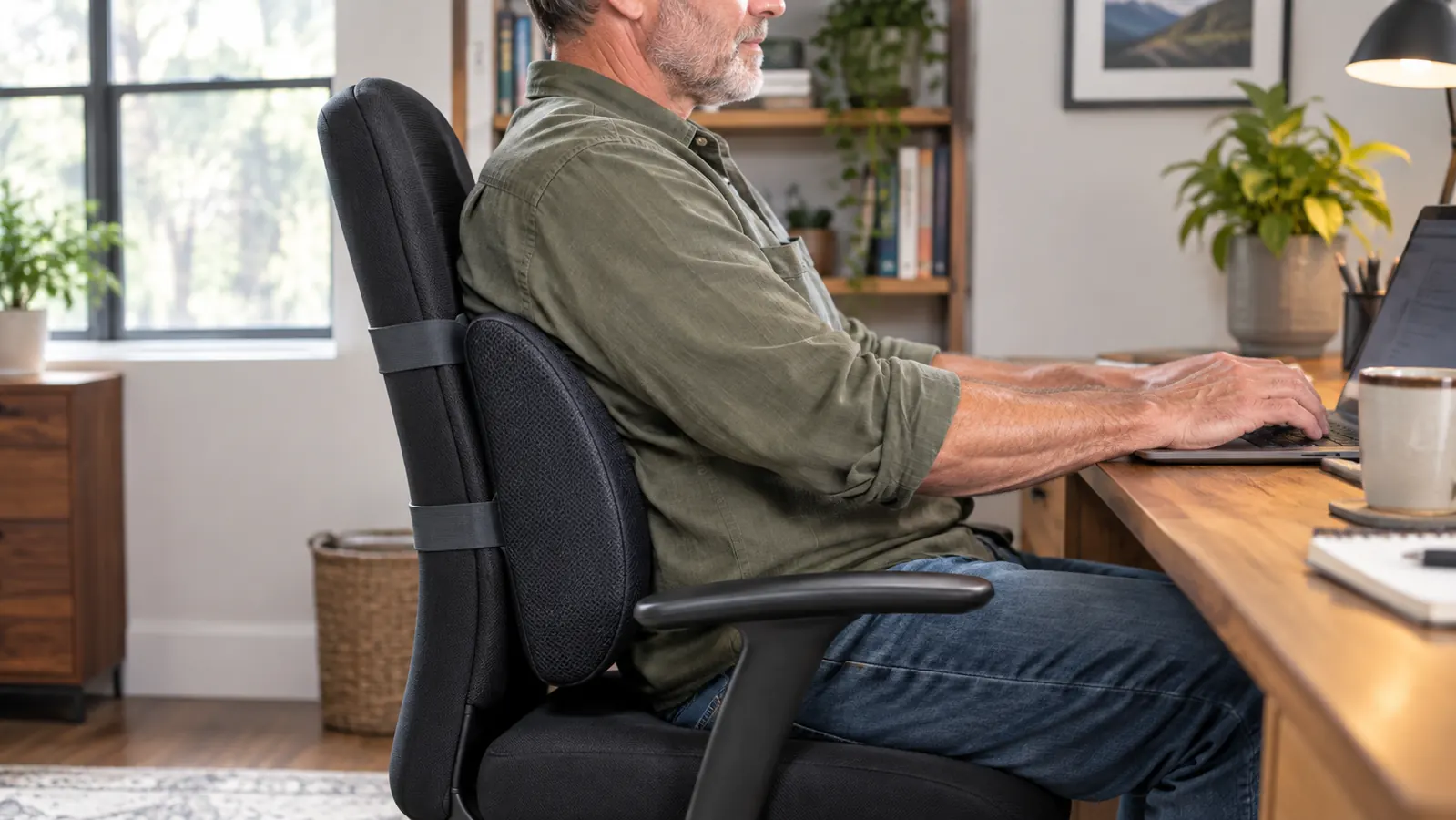
I've been using the QUTOOL pillow for about five months now, and I've put it through the three places I actually sit: my home office chair, the passenger seat of my 2015 Honda CR-V, and the occasional hard chair at my son's place when I visit. The pillow has elastic straps that wrap around the back of a chair, which turned out to be more useful than I expected. It stays put, so I'm not constantly fishing it out from behind my back.
My routine is simple. I strap it to my office chair in the morning, adjust it so the curve sits right at my belt line, and go about my day. On days when I'm driving to see family in Ohio, I move it to the car seat. The transfer takes about ten seconds. That ease of use is the reason it's still in rotation, because I've owned plenty of back gear that felt great in the box and then sat in a closet after week two.
I should also say what I didn't do. I didn't use it as a substitute for my physical therapist's exercises, and I didn't expect a piece of foam to undo decades of wear and tear. I used it as a tool to make sitting more comfortable, and on that job it has been reliable.
The QUTOOL lives in two places in my life. Most of the time it is strapped to the desk chair in the spare room where I pay bills and read the news, and a few times a year it moves to the driver's seat of the CR-V for the long drive to see family in Ohio. Moving it takes about thirty seconds: unclip the strap, carry it out, clip it around the seat back. I thought about buying two, but honestly, carrying one back and forth has never been enough of a hassle to justify it.
Before the QUTOOL, I had tried the usual home remedies. A rolled bath towel worked for about ten minutes before it flattened. A throw pillow from the couch was too soft and too big, so it pushed me forward instead of supporting the curve. A cheap foam wedge from a drugstore was so firm it felt like sitting against a brick. The difference with this pillow is that it is firm enough to hold its shape but gives just enough that it fits the curve of my lower back instead of fighting it.
What the QUTOOL Pillow Actually Does
The QUTOOL Lumbar Support Pillow is a curved block of memory foam with a breathable cover and two elastic straps. That's the whole product, and that's most of what I like about it. There's no complicated mechanism, no inflation valve, no battery, nothing to break. You strap it to a chair, and the curve fills the gap between your lower back and the chair back.
That gap is the problem. Most office chairs are built for a generic body, and if you're not that generic body, your lower back ends up floating in space. The muscles there have to work all day just to hold you upright, and by late afternoon they let you know about it. The QUTOOL pillow fills that space so your back can rest against something instead of holding itself up.
The memory foam is firm enough to hold its shape but soft enough to be comfortable. I've used pillows that felt like a brick wrapped in fabric, and I've used ones that collapsed into a pancake within a month. The QUTOOL sits in the middle, and after five months it still has the same curve it had on day one. The cover is removable and washable, which matters more than you'd think when you use something every day.
The shape is what makes it work. It is thicker in the middle and tapers toward the top and bottom, so it fills the hollow of my lower back without pushing my shoulders forward. When I sit back properly, with my hips all the way to the back of the seat, the pillow takes up the space that used to make me slump. I noticed after the first week that I was not sliding down in the chair over the course of an hour the way I used to. That slow slide was a big part of why my back ached by lunchtime.
How It Held Up Over Time
The honest test of any back support is not how it feels on day one. It's how it feels on day 30, day 60, and day 150, after the novelty has worn off and you're just using it out of habit. The QUTOOL pillow passed that test, with one small caveat.
The foam has held its shape well. I was worried it would develop a permanent flat spot from being compressed all day, but it bounces back overnight. The cover has held up too, with no fraying or pilling after months of daily use and regular washing. The straps are still snug, and the pillow still sits where I put it.
The caveat is the cover. It's soft and breathable, which is good, but it's not the easiest thing to get off and back on. The zipper is small and the fit is snug, so washing it is a bit of a wrestling match. It's a minor annoyance, not a dealbreaker, but I'd be lying if I said I looked forward to laundry day.
After months of daily sitting, the foam has softened a little, but it has not gone flat. I can still see and feel the shape, and it still springs back after I stand up. The strap has stayed tight and the buckle has not cracked, which is more than I can say for the strap on a cheaper cushion I owned years ago. I washed the cover twice, on cold, and let it air dry. It came back fine, though getting it back over the foam took some wrestling. I would not wash it often. A quick wipe is usually enough.
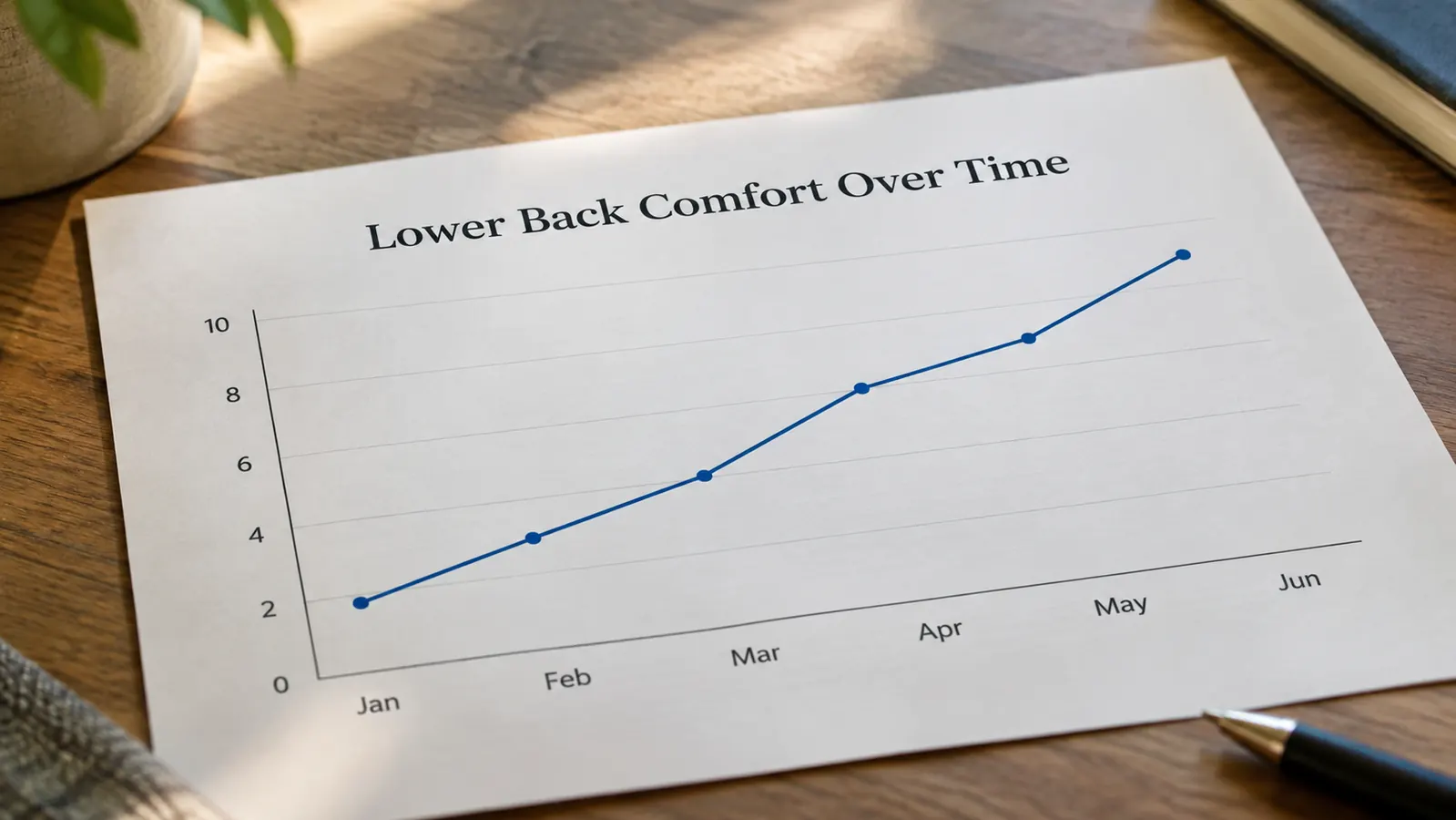
After five months of daily use, the QUTOOL pillow still has the same curve it had on day one. That's the part that surprised me most.
In the Office Chair vs. In the Car
I use the QUTOOL pillow in two main places, and it performs differently in each. In my office chair, it's close to perfect. The straps hold it firmly in place, the curve hits my back at the right height, and I can sit for a full workday without the usual late-afternoon ache. I still get up and move around, because no pillow replaces movement, but the difference is real.
In the car, it's good but not quite as good. The passenger seat of my CR-V has a different shape than my office chair, so the pillow sits a little differently. It still helps, especially on the long drives to Ohio, but I have to adjust it more often. If you're planning to use it mainly in a car, it's worth trying it in your actual seat before you commit.
One thing I'll note: the QUTOOL pillow is not a magic fix for a bad chair. If your office chair is genuinely terrible, with no lumbar support at all and a seat that tilts forward, this pillow will help but it won't transform the chair into something it isn't. It's a support tool, not a replacement for a decent seat.
In the car the pillow matters even more than at the desk, because I cannot get up and walk around whenever I want. On the last drive out to Ohio, about five hours with a couple of stops, I got out at the end without that bent-over shuffle I used to do across the driveway. The one thing to know is that it changes your seating position a little. I had to bring the seat back forward a notch and check my mirrors before I left, so I was not reaching for the wheel. Do that in the driveway, not on the highway.
Who This Is For
The QUTOOL Lumbar Support Pillow is for anyone who sits in a chair that doesn't support their lower back and wants a simple, affordable fix. It's especially good for people who work at a desk all day, because that's where it shines. It's also good for people who drive a lot and want something they can move between the office and the car without a fuss.
It's also for people who, like me, have tried the expensive gadgets and found that a simple piece of foam does the job better. There's something to be said for a product that doesn't need charging, doesn't have an app, and doesn't make you read a manual. You strap it on, you sit down, and you get on with your day.
It is also a good fit for anyone who has been told by a doctor or physical therapist to sit with better support and does not want to buy a whole new chair. A good office chair with built-in lumbar adjustment costs a lot more than this pillow, and most kitchen chairs and car seats have no lumbar support at all. The QUTOOL turns the chair you already own into one that supports the curve of your back. That is not a cure for anything. It is just a more comfortable way to sit for the hours you were going to sit anyway.
Who Should Skip It
If you're looking for a product that will cure your back pain, skip the QUTOOL pillow and talk to a doctor or physical therapist instead. No piece of foam is a substitute for a proper diagnosis and a real treatment plan. I say that as someone who has learned the hard way that back pain is rarely solved by a single purchase.
You should also skip it if you have a chair that already provides good lumbar support. If your chair's built-in support is doing the job, adding a pillow on top can push your back too far forward and create a different kind of discomfort. And if you're looking for a full backrest or a seat cushion, this isn't that. It's a lumbar pillow, and it does one job well.
Skip it too if your chair is very narrow or has a deeply curved back. The pillow needs a reasonably flat seat back to sit against, and on a bucket-style chair it can tip or slide sideways no matter how tight the strap is. And if sitting with support makes your back pain worse rather than better, or if you have pain that travels down a leg, stop using it and talk to a professional. A lumbar pillow is a comfort tool for everyday sitting, and it should never be the thing standing between you and getting a real problem looked at.
What I Liked
- Holds its shape after months of daily use
- Elastic straps keep it firmly in place
- Removable, washable cover
- Simple to move between office chair and car
- Firm but comfortable memory foam
Where It Falls Short
- Cover is a wrestling match to remove and replace
- Not as effective in car seats with a different shape
- Won't fix a genuinely terrible chair
- Not a substitute for professional care for real back pain
Still using it every day, months later
The QUTOOL Lumbar Support Pillow has earned its place in my daily routine. If you spend your days in a chair that doesn't support your back, it's worth a look.
Amazon Check Today's Price on Amazon →