

If you have lived with a cranky lower back for any length of time, you have probably tried the same things I did: a heating pad on the couch, a foam roller on the floor, a massage gun that sounded like a jackhammer, and a posture brace that spent most of its life in the closet. They all helped a little. None of them helped the way a TENS unit does, and the difference is mostly about where you put the pads. I am Glen Haverford, 56, a retired letter carrier who walked a route for 27 years, and I have been using the TENS 7000 for my own lower back stiffness for a while now. This is how I place the pads, what I learned from my physical therapist, and what I would tell anyone who just pulled one of these out of the box.
The TENS 7000 is the unit I keep coming back to. It is a simple, dependable muscle stimulator that sends a mild electrical pulse through pads on your skin, and for everyday muscle stiffness it can be a genuine relief. But the machine only works if the pads are doing their job, and pad placement is where most people go wrong. They slap them on the spot that hurts, turn the dial up, and wonder why it feels like a phone vibrating in their pocket. Let me walk you through the way that actually works.
The TENS 7000 is the unit I keep reaching for when my back flares up
It is simple to use, the pads stick well, and it has enough power to actually do something. Check today's price on Amazon and see if it fits your routine.
Amazon Check Today's Price on Amazon →Step 1: Start with a clean, dry back
The single most common reason a TENS session feels weak or patchy is that the pads are not making good contact. Lotion, sweat, and even a little body oil from the day will sit between the pad and your skin, and the pulse has to fight through it. So before I place anything, I wipe the area with a dry cloth. If I have been doing yard work or just came in from a walk, I wash the area with plain soap and water and dry it thoroughly. No lotion, no oil, no cream. The pads need bare, dry skin to do their job.
This matters more than you would think. I have had sessions where the unit felt like it was barely doing anything, and the fix was simply cleaning the skin and starting over. One evening last fall, after a day of raking leaves, I set up the TENS 7000, sat down in my recliner, and felt almost nothing. I checked the leads, checked the battery, and finally realized the problem: I had skipped the wash-up and the pads were sitting on a layer of sweat and dust. A quick rinse, a dry towel, and the same settings felt completely different. The TENS 7000 comes with a set of pads and the leads that connect them to the unit, and keeping the contact points clean is the cheapest maintenance you can do. It also makes the pads last longer, which matters because replacement pads are the one ongoing cost you will have.
One more thing: check the pads themselves. If they are old, dried out, or losing their stick, they will not conduct well. The TENS 7000's included pads are good quality, but they are not forever. I replace mine when they stop sticking firmly, usually after a few weeks of regular use, and the difference is noticeable. I keep a spare set in the drawer of my nightstand so I am never tempted to stretch a worn pair through another week.
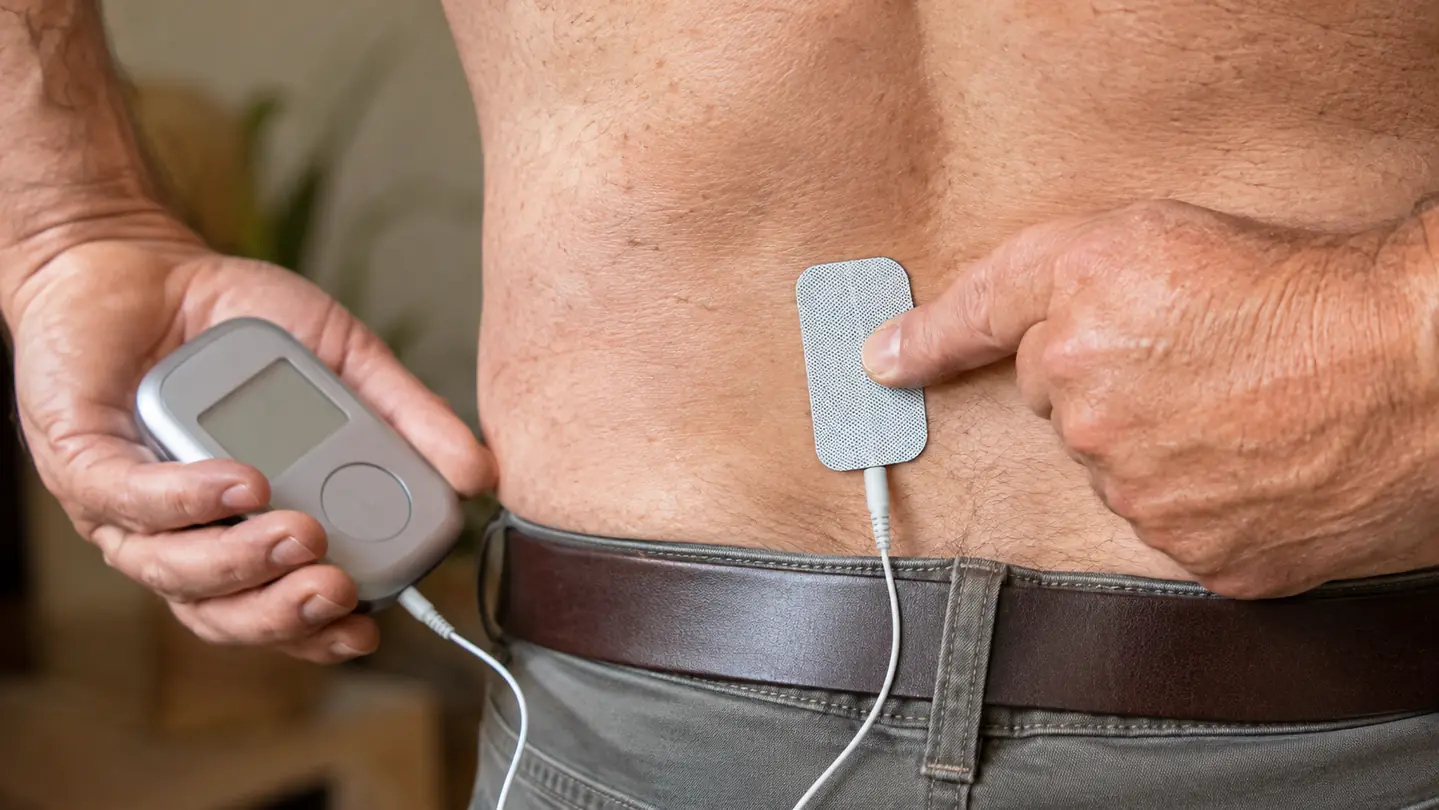
Step 2: Find the right spot, not just the sore spot
Here is the part that took me a while to learn. You do not place the pads directly on the spot that hurts the most. You place them on the muscle that is causing the trouble, which is often a little to the side, a little higher, or a little lower than the pain itself. My physical therapist explained it this way: the pain is where the muscle is complaining, but the muscle runs along your back, and the pads work best when they sit along the length of that muscle, not right on top of the tender point.
For lower back stiffness, I start with the pads on either side of the spine, about an inch or two from the center, at the level of the waist. That puts the pulse along the long muscles that run up and down your back, which is where most of my tightness lives. If the pain is lower, near the belt line, I move the pads down a bit. If it is higher, I move them up. The goal is to have the pads straddle the area, not sit on top of it. When I first started, I put both pads right on the sore spot, about an inch apart, and the result was a strong buzz in one place and no relief anywhere else. Spreading them out along the muscle changed everything.
A good rule of thumb: the pads should be at least an inch apart, and they should never touch each other. If they touch, the current takes the short path between them and does nothing for the muscle underneath. I have made that mistake, and it feels like a tiny zap followed by nothing. Space them out, keep them parallel, and let the current travel through the muscle. On my back, that means the pads sit roughly four to six inches apart, one on each side of the spine, which gives the pulse a good stretch of muscle to travel through.
Step 3: Use two channels for a full coverage pattern
The TENS 7000 has two channels, which means it can run two pairs of pads at the same time. That is a feature worth using. For lower back pain, I run one pair on either side of the spine at the waist, and a second pair lower, near the belt line, angled slightly outward. That gives me coverage of the whole lower back area instead of just one spot, and it feels more like a broad, even release than a single point of buzzing. The first time I tried the two-channel setup, I was surprised at how much more complete it felt compared to a single pair.
The two channels can be adjusted independently, which is handy. If one side of my back is tighter than the other, I can turn that channel up a little and leave the other side where it is. The TENS 7000 makes this easy with separate intensity dials for each channel, and once you get the hang of it, you can dial in exactly what each side needs. Some mornings my left side is the cranky one, usually after a long drive, and being able to give it a bit more attention without overdoing the right side is one of the reasons I stuck with this unit.
If you only have one pair of pads on hand, do not worry. A single pair placed on either side of the spine is still a solid setup. The second pair just adds coverage, and it is one of the reasons I like the TENS 7000 over cheaper single-channel units. The included accessories give you everything you need to run both channels right out of the box, including the extra set of pads and the split leads, so you do not have to buy anything else to get the full coverage pattern.
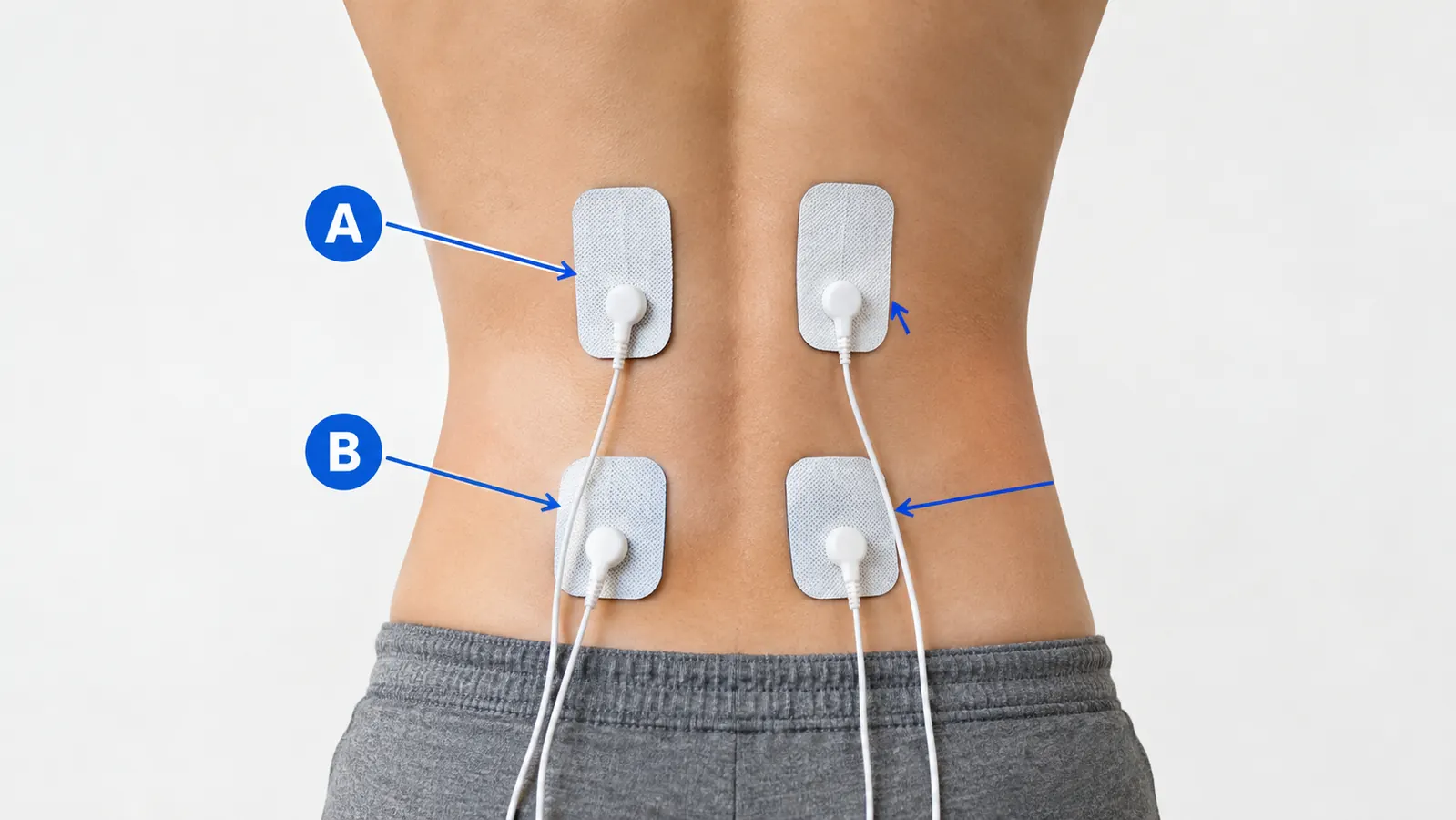
Step 4: Start low and work up slowly
The biggest mistake I see people make with any TENS unit is turning it up too high, too fast. The TENS 7000 has plenty of power, and if you jump straight to a high setting, you will get a strong, uncomfortable sensation that does not actually relax the muscle. The goal is a strong but comfortable tingling, not a jolt. I start on the lowest setting and increase by one level at a time until I feel a clear, steady pulse that is noticeable but not painful. The first time I used it, I made the mistake of cranking it up to see what it could do, and I spent the next ten minutes with a twitching back muscle and no relief.
For my lower back, that usually lands somewhere in the middle of the range. Everyone is different, and the right level depends on your tolerance, the thickness of the muscle, and how tight you are that day. The TENS 7000's digital display makes it easy to see exactly where you are, and the intensity buttons are simple enough to use with one hand, even if you are reaching awkwardly behind your back. I usually settle around level 4 or 5 on a normal evening, and a little higher after a day of heavy work in the yard.
A typical session for me runs about 20 minutes. I set a timer on my phone, because the unit does not have one built in, and I do not want to fall asleep with it running. Twenty minutes is enough to feel the benefit, and it is short enough that I can fit it in before dinner or after a drive. If it feels good, I might do another session later in the day, but I do not run it for hours at a stretch. On the days I drive to Ohio to see family, I will run a session about an hour after I get out of the car, and that has become part of the routine.
Step 5: Adjust for the situation
The placement that works for a general flare-up is not always the placement that works for a specific situation. If my back is stiff after a long drive in my 2015 Honda CR-V, I place the pads a little lower, right at the belt line, because that is where the seat presses. If it is tight after yard work, I place them a little higher, because that is where the bending and lifting hit. The TENS 7000 is forgiving, and a small adjustment can make a big difference. After a six-hour drive to my brother's place in Ohio last spring, the lower placement at the belt line was the only thing that got me through the next day.
I also adjust the settings for the situation. After a drive, I use a lower intensity and a longer session, because the muscle is more fatigued than tight. After yard work, I use a slightly higher intensity and a shorter session, because the muscle is tighter and needs a stronger pulse to get it to let go. This is not science, it is just what I have found works for me, and I would encourage you to experiment within the comfortable range. Keep a little notebook or a note on your phone about what placement and level worked for which activity, because you will not remember it a month from now.
One thing I will say plainly: the TENS 7000 is a tool for easing muscle stiffness, not a cure for anything. If your pain is sharp, if it radiates down your leg, if it came on suddenly, or if it does not improve after a few days, see a doctor or a physical therapist. I have been managing my back for a decade, and the TENS unit is part of my routine, not a replacement for the exercises my physical therapist gave me. It eases the stiffness so I can do the work that actually keeps me moving.
What Else Helps
The TENS 7000 works best when it is part of a routine, not the whole routine. For me, that means a few minutes on a foam roller in the morning, the TENS unit in the evening when my back is tight, and the stretching program my physical therapist wrote out for me. Heat helps before activity, ice helps after, and a good night's sleep on a supportive mattress does more than any gadget. The TENS unit is the piece that gives me relief when nothing else is convenient, and that is why it earns its place in my garage gym and my living room. I keep it in the drawer of the end table next to my recliner, with the spare pads and the USB cable, so I do not have to go hunting for it when my back starts to complain.
The TENS 7000 is the piece that gives me relief when nothing else is convenient, and that is why it earns its place in my routine.
If your back is as cranky as mine, the TENS 7000 is worth a try
It is simple, it is dependable, and it has been a steady part of my routine for a long time. Check today's price on Amazon and see if it fits your routine.
Amazon Check Today's Price on Amazon →