

If you sit at a desk for a living, you already know the feeling. Forty minutes in, your lower back starts to complain. You shift, you slouch, you hook one leg under the chair, and none of it helps for long. I carried a mail route for 27 years, so I spent most of my working life on my feet. Now that I'm retired and spend more time at a desk than I ever expected, I've learned that sitting can be just as hard on a cranky back as walking in the snow. The QUTOOL Lumbar Pillow is the piece of gear that finally made my chair work with my back instead of against it, but only after I figured out how to set it up properly.
Here's the thing nobody tells you. A lumbar pillow is not a magic cushion you toss onto a chair. It's a tool, and like any tool, it only works when you put it in the right place and adjust it for your body. I learned that the hard way over about a week of fiddling. This guide is the setup routine I wish I'd had on day one, the same five steps I now use every time I sit down to work.
The QUTOOL Lumbar Pillow is the support I reach for every single day
It took me a week of fiddling to get the setup right, and now I don't think twice about it. If you want the same support without the trial and error, the QUTOOL Lumbar Pillow is on Amazon and it's worth a look.
Amazon Check Today's Price on Amazon →Step 1: Start With a Chair That Fits You
Before you touch the pillow, look at the chair. A lumbar support can't fix a seat that's the wrong size for you. When I sit all the way back in my chair, I want my feet flat on the floor and my knees at about a right angle. If the seat is so deep that the front edge presses into the back of my knees, no pillow in the world is going to make that chair comfortable. If that's your situation, adjust the seat depth first, or add a seat cushion to bring you forward.
The same goes for height. Your hips should sit slightly higher than your knees, which takes pressure off your lower back. Raise or lower the chair until that's true. This is the boring foundation work, and it matters more than any pillow. I skipped it at first and wondered why my back still ached. Once I fixed the chair height, the QUTOOL pillow had a proper base to work from.
One more thing. If your chair has a built-in lumbar support, set it to its lowest or flattest position before you add the pillow. Two supports stacked in different places will fight each other. You want one clear point of support, and you want it to be the pillow you can adjust.
Before you put the pillow in, sit in the chair as it is and pay attention. Do your feet rest flat on the floor? Do your thighs sit level, or do your knees point up? Can you sit all the way back without the front edge of the seat pressing into the backs of your knees? Write those answers down if it helps. When I did this at my own desk, I realized the chair was too low, so I was sitting with my knees higher than my hips, which tipped my pelvis back and made my lower back round no matter what I put behind it.
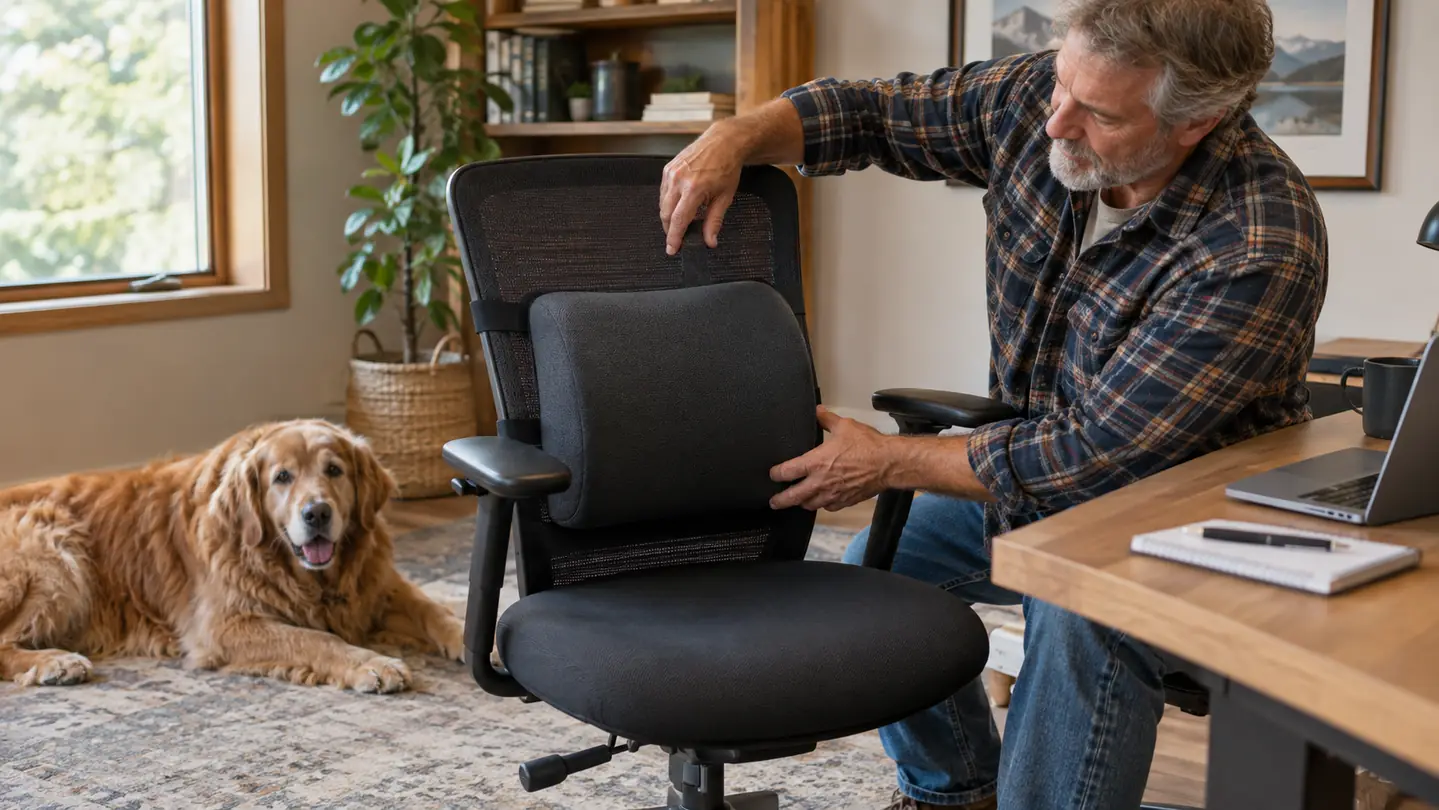
Step 2: Place the Pillow at the Right Height
This is the step most people get wrong. The pillow is not for your mid-back and it's not for your tailbone. It's for the natural inward curve of your lower back, which sits just above your belt line. When I first tried the QUTOOL pillow, I had it too low, more or less under my belt, and it pushed my hips forward into a position that made my back ache worse. I had it too high another time, and it felt like I was leaning into a shelf.
The right height is the spot where your back has a hollow. If you sit up straight and put your hand behind you, you can feel the curve just above your waist. That's where the pillow goes. The QUTOOL pillow has a strap that wraps around the chair back, so once you find the spot, you can secure it and it stays put. That strap is a small thing, but it's the difference between a pillow that works and a pillow that slides down behind you by noon.
A good test: sit back and see if the pillow fills that hollow without forcing you into an exaggerated posture. You should feel supported, not pushed. If you feel like you're being levered forward, drop the pillow an inch and try again.
Step 3: Adjust the Depth So It's Firm, Not Pushing
The QUTOOL pillow is made of memory foam, and memory foam has a break-in period. Out of the box, it's firmer than you might expect. That's not a flaw. It's the foam doing its job. The mistake I made was assuming that if a little support was good, a lot of support was better. I wedged myself against the pillow as hard as I could, and within an hour my back was complaining in a new way.
The goal is light, consistent contact. You want the pillow to hold your back in a neutral position, not to shove it forward. If the pillow is too deep for you, you can use the strap to position it slightly higher or lower, or you can let it sit a little looser against the chair back. Over the first few days, the foam will soften and mold to your shape. Give it that time before you judge it.
Here's the test I use. I sit back, take a breath, and let my shoulders relax. If I can feel the pillow holding the curve of my lower back without having to brace against it, the depth is right. If I'm fighting it, I adjust. This is a five-second check I do every time I sit down, and it's the reason the QUTOOL pillow still works for me months later.
The QUTOOL has a strap that goes around the back of the chair, and it is worth getting it snug. If the pillow can slide down, it will, slowly, over the course of a morning, and you will end up with it behind your hips instead of your lower back. I tightened mine, sat down, stood up, sat down again a few times, and then checked where it ended up. It stayed put. If your chair has a mesh back, the strap matters even more, because the pillow has nothing solid to press against and wants to sink into the mesh.

Step 4: Sit Back, Then Fine-Tune
Once the pillow is in place, sit all the way back in your chair and let your body settle. This is the step people rush. They place the pillow, perch on the front edge of the seat, and wonder why it's not helping. You have to actually lean back into the support. Your lower back needs to be in contact with the pillow for it to do anything.
Now fine-tune. If the pillow feels too high, drop it half an inch. Too low, raise it. Too firm, let the strap out a little. I keep a small notebook next to my desk, and for the first week I jotted down what felt off each day. That sounds fussy, but it's how I found the exact position that works for me. Everyone's spine is a little different, and the QUTOOL pillow is adjustable enough to match yours if you take the time.
One warning. If you feel any sharp pain, numbness, or tingling, stop and check your setup. A support pillow should ease discomfort, not cause it. If the problem doesn't go away with adjustment, talk to a doctor or physical therapist. I'm not a medical professional, and I don't pretend to be one. I'm just a guy who has spent a lot of years learning what helps his own back.
Step 5: Build the Habit of Getting Up
Here's the part I didn't want to hear, and you probably don't either. No pillow, no matter how good, is a substitute for getting out of the chair. The QUTOOL pillow makes the time I do spend sitting much more comfortable, but my back is happiest when I stand up every 45 minutes or so. I set a timer on my phone. When it goes off, I stand, stretch, walk to the kitchen, and come back. It takes two minutes.
I also do a couple of the exercises my physical therapist gave me years ago. A standing back extension, a gentle knee-to-chest stretch, a few shoulder rolls. Nothing dramatic. The point is to remind my back that it can move in more than one direction. Sitting in one position for hours, even a good position, is what gets me into trouble.
A simple trick that helped me build the habit was setting a timer on the kitchen stove for every forty-five minutes. When it went off, I stood up, walked to the end of the hall and back, and sat down again, all the way to the back of the seat. Most days I ignored the timer once or twice, which is fine. The point is not perfection. The point is that a good chair setup makes sitting more comfortable, but no setup makes sitting for three hours straight a good idea. Your back still wants you to get up and move now and then.
Think of the pillow as the support that keeps you comfortable while you work, and the breaks as the support that keeps you comfortable after work. You need both. The QUTOOL pillow is the best tool I've found for the sitting part. The standing part is up to you.
What Else Helps
A lumbar pillow is one piece of a bigger picture. A few things that made a real difference for me: a footrest under my desk so my knees stay at a comfortable angle, a monitor raised to eye level so I'm not craning my neck, and a chair with armrests that let my shoulders relax. I also keep a heating pad in the living room for the days when my back is extra cranky, and I use a foam roller in the garage gym more often than I used to. None of these are fancy. They just work together.
If you're just starting out, don't buy everything at once. Start with the pillow, set it up properly, and see how it feels for a week. Then add what's still missing. That's how I built my setup, one piece at a time, and it's how I ended up with a desk I can actually sit at without dreading the afternoon.
The QUTOOL pillow is the best tool I've found for the sitting part. The standing part is up to you.
Set your chair up right, and the QUTOOL Lumbar Pillow does the rest
Five steps, about ten minutes, and a back that doesn't complain by mid-afternoon. That's what this pillow gave me. If you want to try it, the QUTOOL Lumbar Pillow is on Amazon and the current price is easy to check.
Amazon Check Today's Price on Amazon →